A battery quoted as 10 kWh may not deliver 10 kWh to the customer’s AC loads. Nominal capacity describes the battery’s stated energy. Usable capacity describes energy available within a defined operating window, and the definition should say where that energy is measured.
When comparing offers, ask each supplier to write down the capacity basis. You can then account for reserve and conversion losses once, without subtracting them again from a figure that already includes them.
Follow the capacity from the battery to the load
Look for these labels in the offers you receive:
| Figure on the quotation | Detail needed to interpret it |
|---|---|
| Nominal battery energy | Rated voltage, capacity and reference conditions |
| Usable DC energy | Permitted operating window and measurement conditions |
| Usable AC energy | Conversion boundary, load and included system consumption |
| Energy available for routine cycling | Any additional reserve held for backup |
The SAM battery-model documentation distinguishes nominal battery capacity from available or usable capacity. In a purchase specification, add the supplier’s exact definition alongside the number.
A quotation that says only “usable: 9 kWh” leaves several questions open. Is that measured at the battery terminals? Does it include the inverter? Is the backup reserve already deducted? Those answers can change the equipment needed for the job.
Work through one quote without counting the reserve twice
Assume a hypothetical battery has 10 kWh nominal energy and allows operation between 10% and 100% state of charge. That is a 90-percentage-point operating window, or 9 kWh on a simplified nominal-energy basis.
Now suppose the owner wants to preserve charge below 30% for outages during routine operation. Routine cycling from 100% down to 30% uses a 70-percentage-point window, equivalent to 7 kWh on the same simplified basis. The portion from 30% down to the 10% lower limit is 2 kWh.
The routine figure is not 9 kWh minus 30% of 9 kWh. The reserve setting refers to the stated state-of-charge scale. Keeping the endpoints visible avoids that mistake.
At an assumed 94% discharge-path efficiency, the 7 kWh DC allowance would correspond to about 6.58 kWh AC before any separately accounted auxiliary consumption. These are arithmetic examples, not performance claims for a particular battery.
For an actual project, use the supplier’s warranted or measured usable-energy basis where provided. State-of-charge percentages and energy fractions need not track perfectly under every condition.
What the SH5KFL’s 5.12 kWh figure tells you
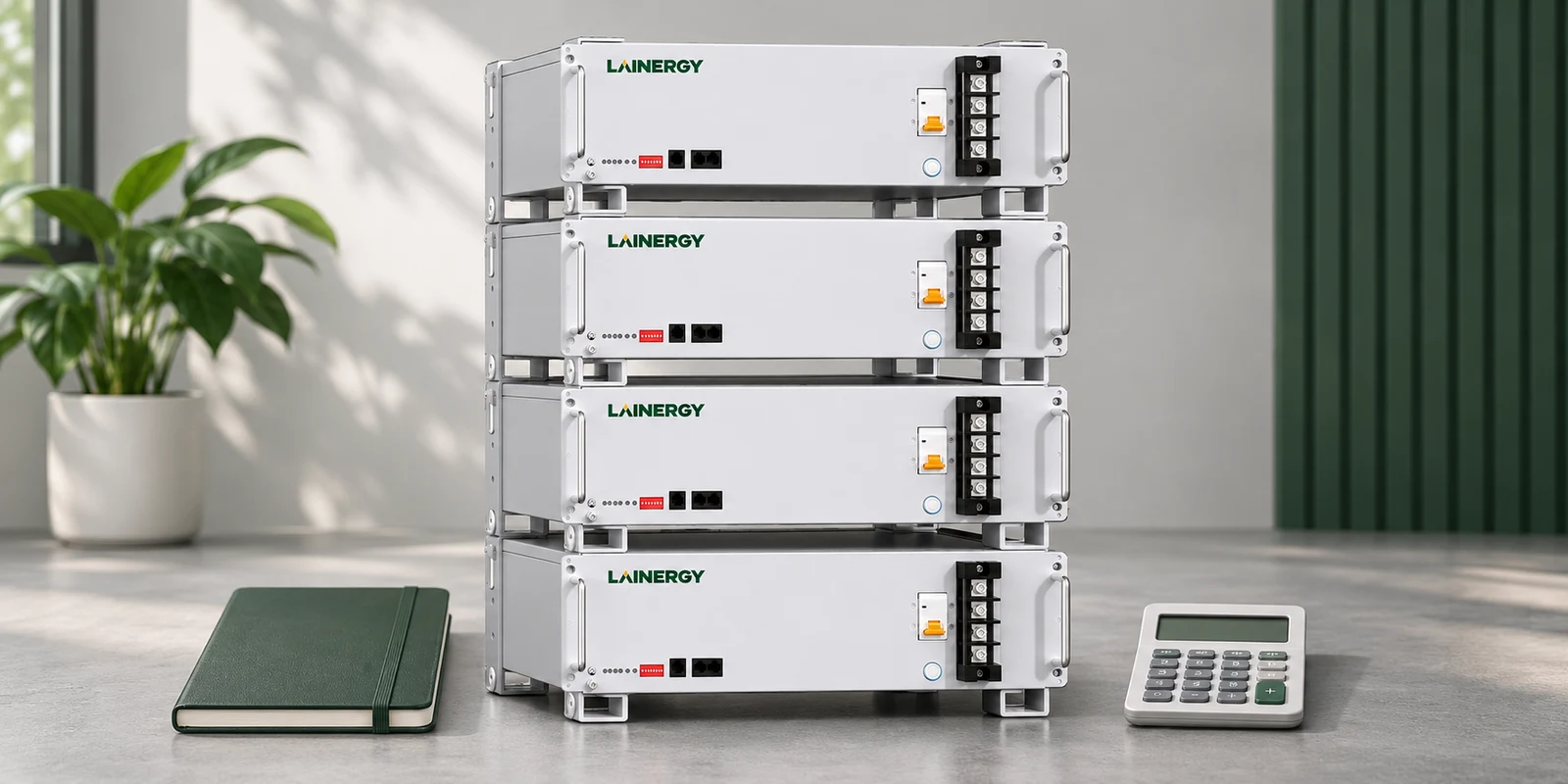
The LAINERGY SH5KFL lists 51.2 V and 100 Ah per module. Multiplying those nominal figures gives 5,120 Wh, or 5.12 kWh. Two modules represent 10.24 kWh nominal energy.
That calculation is useful for checking a quotation, but the AC energy available to the building still depends on the supported configuration and operating conditions. Ask for the usable-energy definition and agreed reserve settings for the proposed bank.
Keep power capability beside the capacity figure. Two systems with the same kWh can have different continuous output limits. The 48 V and 51.2 V battery article includes a current calculation that explains this part of the pairing.
Leave room for the actual service requirement
If the customer needs a certain amount of energy at the end of the service period, the proposal needs a capacity-retention assumption as well as the starting capacity. Record whether that assumption comes from a warranty, a simulation or the purchaser’s own design requirement.
Temperature and discharge rate also belong in a capacity test specification. A delivered-energy claim should identify the load, starting condition and stopping condition so the result can be reproduced.
For backup projects, ask whether the requested duration assumes the battery starts full. A battery used for daily energy shifting may be at a lower state of charge when an outage begins. The customer needs an operating policy that leaves the intended energy available.
A clearer way to request capacity
Write the requirement in terms of the load: the AC energy needed during the stated period, the starting reserve policy and the expected operating conditions. Then ask the supplier to show how the proposed nominal capacity meets it.
For a residential battery quote, send that requirement and the inverter model to LAINERGY. Request separate lines for nominal energy, usable DC energy and the assumptions behind the AC estimate. That makes offers with different capacity labels easier to compare.