A 51.2 V LiFePO4 battery may be suitable for an inverter marketed as a 48 V model. The two labels can describe the same broad system class, but they do not guarantee compatibility. Check the battery’s full operating range, charging requirements, current limits and BMS communication against the exact inverter.
For an importer replacing an existing battery SKU, the distinction matters: matching the nominal voltage on a brochure is only the first check. The order must specify how the battery and inverter behave together across charging, discharge and protective shutdown.
Why the labels differ
A common LFP cell has a nominal voltage of 3.2 V. Sixteen such cells in series give 51.2 V nominal; fifteen give 48 V nominal. Meanwhile, “48 V system” is also used as a general equipment category. This is why an inverter label and a battery’s nominal specification can use different numbers.
Nominal voltage is a reference value, not a fixed terminal voltage throughout a cycle. A battery’s actual voltage changes with operating conditions and state of charge. The configured upper and lower limits must come from its own documentation.
As an independent example of this distinction, Victron’s 51.2 V battery specification lists a separate charge-voltage range. Its settings apply to that product, not automatically to LAINERGY batteries.
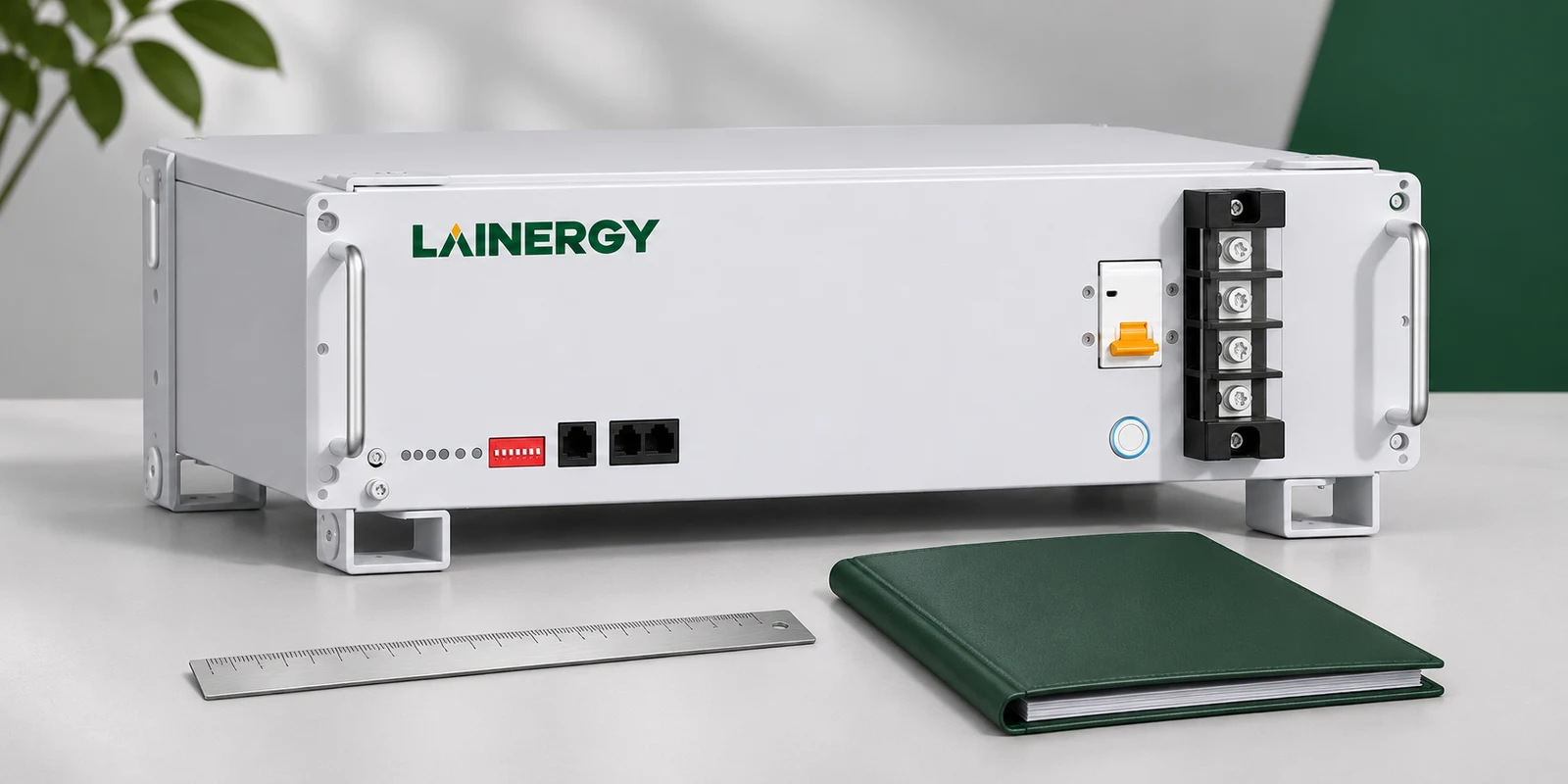
Compare five fields before approving a replacement
| Field | Battery information | Inverter information |
|---|---|---|
| Voltage | Nominal voltage and permitted operating range | Battery input range and configurable thresholds |
| Charging | Charge limit and temperature-dependent current | Supported profile and maximum combined charging current |
| Discharging | Continuous and temporary current limits | Battery current needed at the intended AC output |
| Communication | Protocol, firmware and connector pinout | Supported battery profile and communication settings |
| Expansion | Approved parallel arrangement and module limits | Supported bank capacity and control arrangement |
Keep the electrical limits and communication checks separate. A system can be inside the voltage range yet fail to exchange current limits or state-of-charge information correctly. Conversely, a menu showing a familiar battery protocol does not establish that the battery can supply the required current.
Compare two actual 51.2 V batteries
LAINERGY’s SH5KFL stackable battery is listed at 51.2 V, 100 Ah and 5.12 kWh per module, with a published operating range of 43.2–57.6 V. The CB-5-W wall battery also lists 51.2 V, 100 Ah and 5.12 kWh, but provides its own charge and discharge limits.
The shared nominal energy follows directly from voltage multiplied by capacity: 51.2 V × 100 Ah = 5,120 Wh. This calculation does not establish the usable AC energy after reserve and conversion losses.
Nor should the SH5KFL’s operating range be copied into the CB-5-W inverter settings. For the wall battery, the published information includes a 56.16 V charging cutoff and 45.6 V discharge cutoff. Request the recommended operating settings for the selected pairing; a protective cutoff is not necessarily the preferred everyday operating target.
Check current at the intended load
Suppose an installer wants 5 kW AC from a nominal 51.2 V battery. At an assumed 92% inverter efficiency, the approximate DC current is:
5,000 W ÷ (51.2 V × 0.92) = 106 A.
This is a planning example, not a product test. It already exceeds the CB-5-W’s published 100 A continuous discharge figure, even before considering lower operating voltage or other constraints. A 5.12 kWh energy label therefore does not automatically mean that one module can continuously support a 5 kW AC load.
The appropriate response is to assess a supported larger bank or a different load requirement. Do not simply increase an inverter setting beyond the battery rating. Ask for the supported parallel configuration and the resulting system-level current limit.
Questions worth resolving before sample shipment
Can a 48 V lead-acid profile be reused? Do not assume so. Charge stages, voltage targets and protective behavior must match the lithium battery requirements. Give the supplier the existing inverter model and firmware so it can identify the correct profile.
Does CAN or RS485 mean plug-and-play? No. These interface names do not identify the complete application protocol or pinout. Request the connection instructions and supported firmware combination.
Can different 51.2 V batteries be mixed? A shared voltage is insufficient. Use only a combination explicitly supported by the manufacturer, including the communication and current-sharing arrangement. Expansion also needs an agreed procedure for modules of different ages or charge states.
Make the acceptance check reproducible
Record the inverter model, battery model, firmware versions, cable specification and approved settings. During a qualified sample evaluation, verify displayed battery information, normal charging, intended load operation and the documented response to a communication fault. Record observations against the agreed limits rather than accepting a screenshot showing “connected.”
Browse residential batteries for the relevant format. Send the inverter datasheet, target continuous load and desired capacity through the LAINERGY inquiry form to request a supported battery configuration.