At the same power and efficiency, a 48 V battery system draws roughly half the current of a 24 V system. That can make higher-power DC distribution more manageable, but it does not mean a 48 V inverter is automatically the right choice for every project.
Choose the voltage architecture together with the load, battery, inverter and charging equipment. A change from 24 V to 48 V is a system decision, not a settings adjustment on equipment designed for another voltage.
Compare current at equal output
For a simplified estimate:
Battery current = AC power ÷ (battery voltage × inverter efficiency).
Using an illustrative 3,000 W AC load and 92% efficiency gives:
| Assumed battery voltage | Approximate DC current |
|---|---|
| 24 V | 136 A |
| 48 V | 68 A |
| 51.2 V | 64 A |
The figures use fixed assumed voltages and efficiency. Actual current changes as battery voltage and conversion efficiency change. Design checks must include the relevant low-voltage operating condition and the equipment’s continuous and temporary limits.
Why the current difference matters
For the same conductor resistance, resistive loss follows current squared multiplied by resistance. Halving current reduces that particular loss to one quarter. This does not mean total system losses fall by 75%; many other losses and design choices remain.
Victron’s Wiring Unlimited reference explains DC wiring, resistance and voltage-drop considerations. Cable and protective-device selection must follow the actual installation requirements, conductor conditions and equipment instructions.
For procurement, request the recommended connection arrangement and applicable current limits. Do not select cable size from system voltage alone.
Amp-hours do not compare energy across voltages
A nominal 24 V, 100 Ah battery represents 2.4 kWh, while a nominal 48 V, 100 Ah battery represents 4.8 kWh. The same amp-hour number therefore describes different nominal energy.
When comparing quotations, normalize to the required usable energy and supported output. A higher-voltage battery is not a free increase in capacity; its configuration and price need to be assessed on a consistent energy basis.
The same care applies to 48 V and 51.2 V labels. A battery can be marketed in a broad 48 V class while listing 51.2 V nominal. Use its actual operating range and charging requirements for the compatibility review.
Place real inverter models in the correct class
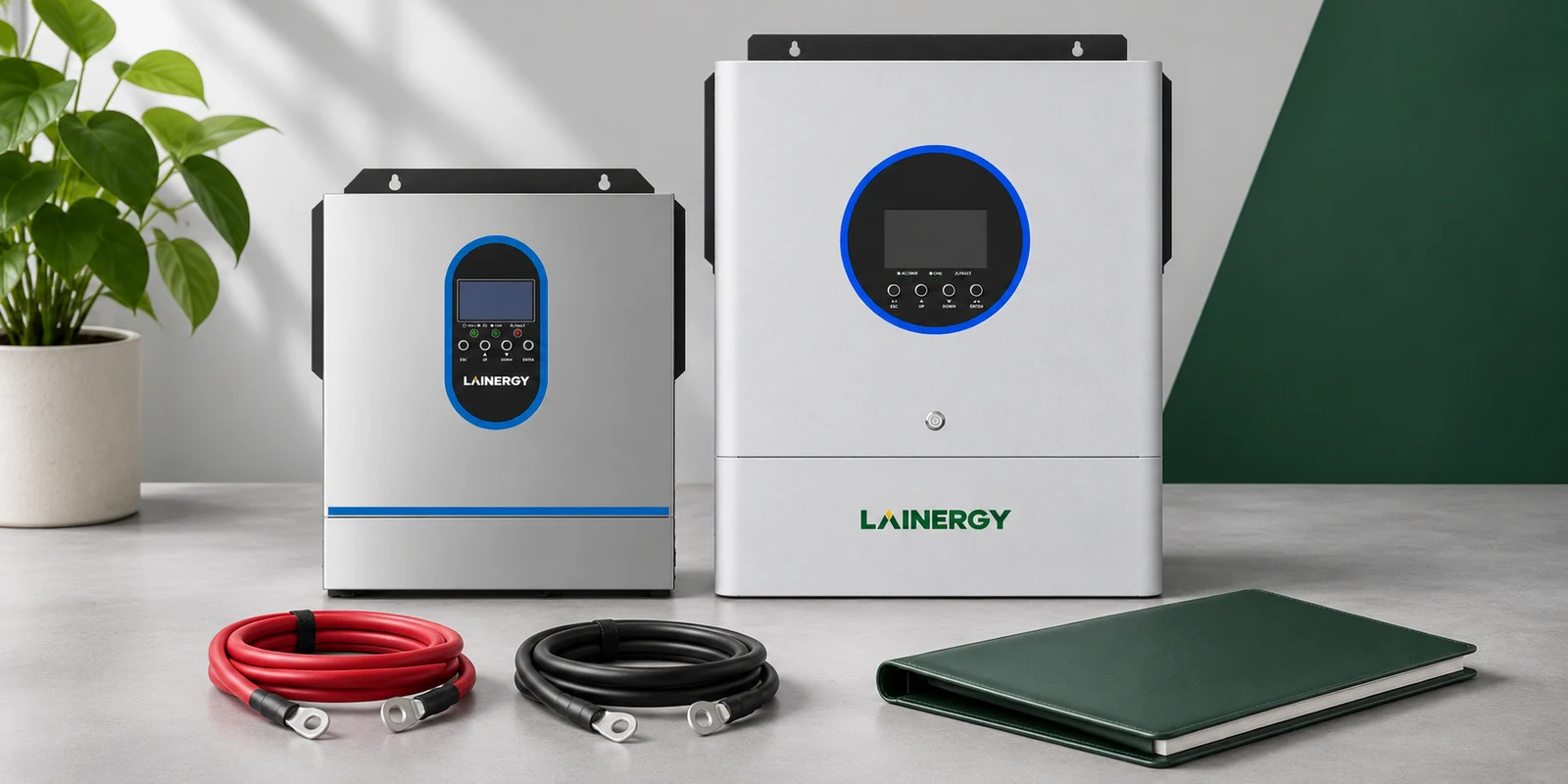
The LAINERGY WP-3.5K lists 3.5 kW output and a 24 V battery system. The WP-8.5K lists 8.5 kW and a 48 V battery system. These are different output classes, not two interchangeable voltage settings of one inverter.
The hybrid inverter range also needs to be evaluated by model and operating mode. An installer should first identify the required AC behavior, then select a compatible DC architecture.
When retaining 24 V may be reasonable
An existing project may already have suitable 24 V equipment and a load requirement within its supported limits. Replacing the architecture could require changes to the battery, charging equipment and other DC components. Compare that scope with the actual benefit of the proposed upgrade.
For a new higher-power project, assess 48 V options early because current requirements become significant as output increases. This is a design consideration, not a universal power threshold that applies to every manufacturer.
Do not series-connect complete batteries to create a higher voltage unless the manufacturer explicitly supports that arrangement. Integrated BMS and communication designs can impose restrictions that are not apparent from the nominal voltage.
Prepare a system-level inquiry
Send the simultaneous load, largest startup load, required duration, existing equipment and destination AC voltage to LAINERGY. Identify whether the project is new or a retrofit.
Request a comparison covering the off-grid inverter, supported battery configuration and charging limits. Keep nominal voltage, nominal energy and delivered AC power as separate fields so the quotation answers the complete system requirement.