Choose a stackable battery when the project’s supported expansion arrangement and floor layout favor modules. Choose a wall-mounted battery when the approved mounting location, wall structure and service access suit that enclosure. The format alone says little about electrical compatibility, usable capacity or outdoor suitability.
For installers and distributors, compare the installed arrangement rather than the product photograph. Include handling, access, cable routes, future capacity and the work required to replace a module.
Start with the available space
A wall battery uses wall area and requires a suitable supporting structure and approved mounting hardware. A stack uses floor space and needs the manufacturer’s permitted module arrangement. Both require access and clearances defined in their installation documentation.
Do not assume stacking means unlimited height, or that a compact wall enclosure can be fitted in any cupboard. Obtain the dimensions of the complete installed arrangement, including brackets, bases, connectors and service space.
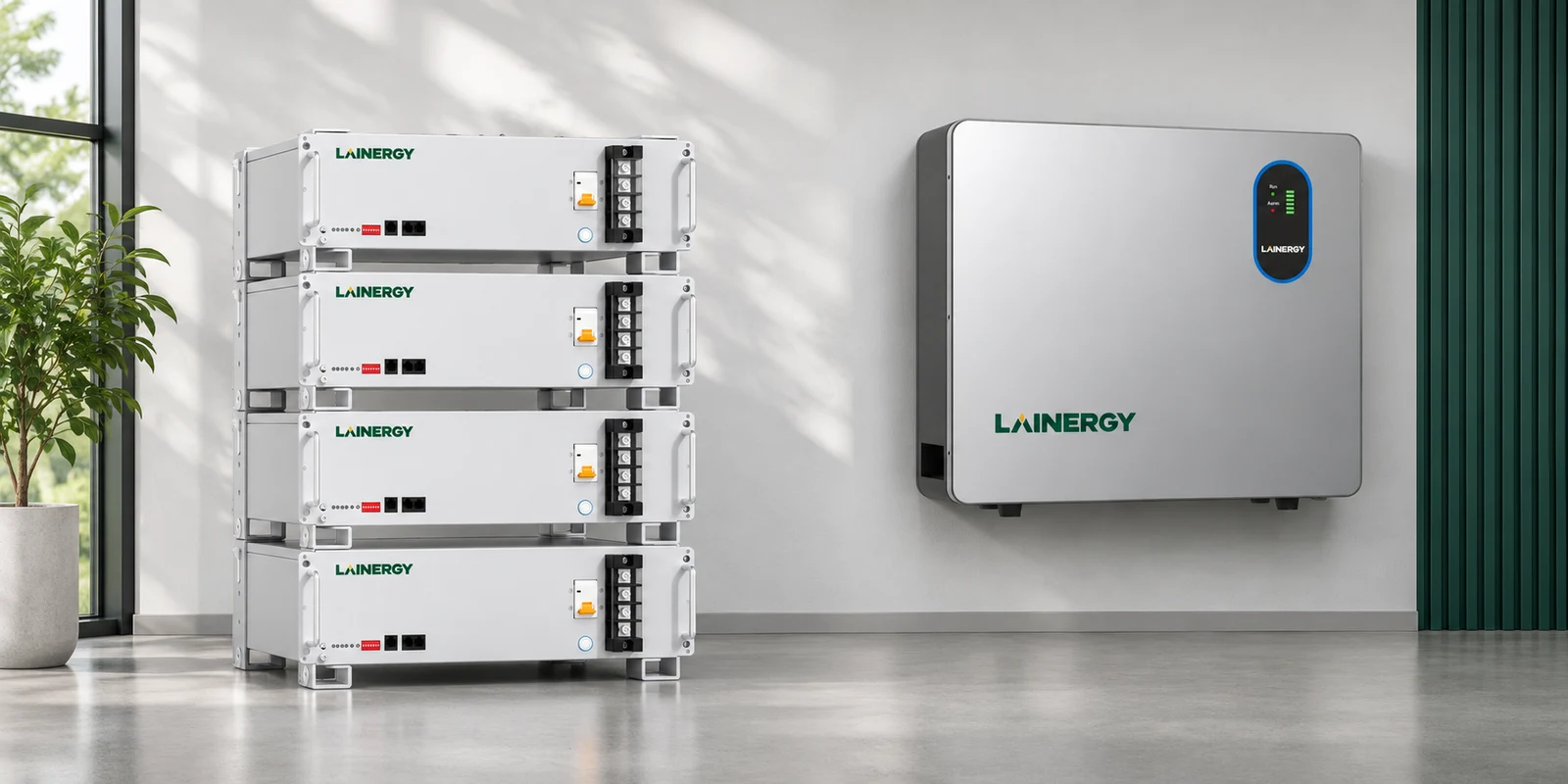
A comparison using two 5.12 kWh formats
LAINERGY’s SH5KFL is a 51.2 V, 100 Ah stackable module with 5.12 kWh nominal energy. Its published range describes expansion up to ten modules. The CB-5-W is a wall battery also listed at 51.2 V, 100 Ah and 5.12 kWh.
Equal nominal energy makes them useful for a format comparison, but does not make their settings, discharge limits or installation requirements interchangeable.
| Decision | Stackable arrangement | Wall-mounted arrangement |
|---|---|---|
| Space | Assess complete stack footprint and height | Assess usable wall area and support |
| Handling | Plan module movement and assembly | Plan lifting and bracket installation |
| Expansion | Confirm module limit and approved architecture | Confirm whether parallel expansion is supported |
| Service | Check access to each module and its connections | Check access around the mounted enclosure |
| Electrical fit | Verify complete bank current and communication | Verify battery current and communication |
| Environment | Follow the specific model’s installation limits | Follow the specific model’s installation limits |
Expansion needs an electrical plan
Four 5.12 kWh modules represent 20.48 kWh of nominal energy. That arithmetic does not determine the bank’s supported power, usable AC energy or the number of modules the inverter can manage.
For a staged installation, ask whether future modules must use the same hardware and firmware and how additions are commissioned. Document the supported module count and the supplier’s procedure for bringing a new module into an existing bank.
An expansion claim also needs a defined wiring and communication arrangement. “Up to ten modules” should not be interpreted as permission to assemble any physical stack or parallel connection without the approved instructions.
Protection rating is only part of the location decision
The SH5KFL page lists IP21, while the CB-5-W page lists IP65 and describes an indoor wall battery. The higher ingress-protection figure does not independently authorize an outdoor installation. Temperature, sunlight, condensation, mounting orientation and the manufacturer’s intended location still matter.
Use the current installation manual for the exact model. As a separate manufacturer example, Victron’s battery manual treats mounting and operating conditions as dedicated subjects rather than relying on an enclosure rating alone.
Include service costs in the comparison
Ask how an installer identifies a faulty module, obtains logs and replaces the affected unit. Establish whether the system must be shut down, which parts are supplied separately and how replacement stock is managed.
For wholesale supply, request package dimensions and handling information as well as product dimensions. The format that looks smaller on a wall may not have the lowest delivered or installed cost for a particular project.
What to send with the inquiry
Prepare a simple room sketch, photos of the proposed location, intended inverter model, initial capacity and possible future capacity. Add the destination country and environmental conditions.
Review the residential battery range and send the brief to LAINERGY. Request the supported configuration, installation dimensions and expansion procedure for each suitable option. This gives the installer a practical comparison rather than a choice based only on appearance.