Choose between a hybrid inverter and an off-grid inverter by defining how the project should operate with and without an AC supply. A hybrid design coordinates solar and battery functions; an off-grid design is intended to support loads independently of the utility. Product labels overlap, so the actual input, output and control capabilities must decide the purchase.
An off-grid inverter may have an AC input for bypass or charging. A hybrid inverter may require additional equipment for backup operation. Neither label alone establishes grid-export approval, generator compatibility or uninterrupted supply.
Start with the site’s three operating states
Write down the required behavior during normal supply, a supply outage and battery depletion. This exposes differences that are easy to miss in a price comparison.
| Site state | Question to resolve | Purchase implication |
|---|---|---|
| Grid available | Should solar serve loads, charge batteries or export? | Specify supported power flows and controls |
| Grid unavailable | Which loads must operate and for how long? | Define backup power, energy and transfer needs |
| Battery at reserve | Should loads stop or transfer to another source? | Confirm transfer and restart logic |
| Solar returns | Can the system restart in the required configuration? | Confirm recovery conditions |
| Optional generator available | Can the inverter accept that source and manage charging? | Verify the exact generator interface and limits |
The US Department of Energy’s microgrid explanation distinguishes independent operation from ordinary grid-connected behavior. For procurement, translate that distinction into a required operating sequence rather than treating every solar inverter as backup equipment.
Two projects that need different answers
A remote workshop might prioritize independent daytime operation, evening battery supply and a defined fallback source. Its buyer should focus on the supported off-grid architecture, startup loads, battery current and recovery after depletion. Export functionality may have no value for that site.
A grid-connected shop might prioritize daytime self-consumption and selected backup circuits. Here, the buyer needs to distinguish energy management during normal operation from behavior during an outage. If export is required, it becomes a separate model and approval requirement.
These are illustrative purchasing scenarios. They do not establish that every inverter in either category supports the described configuration.
Compare actual models without mixing their ratings
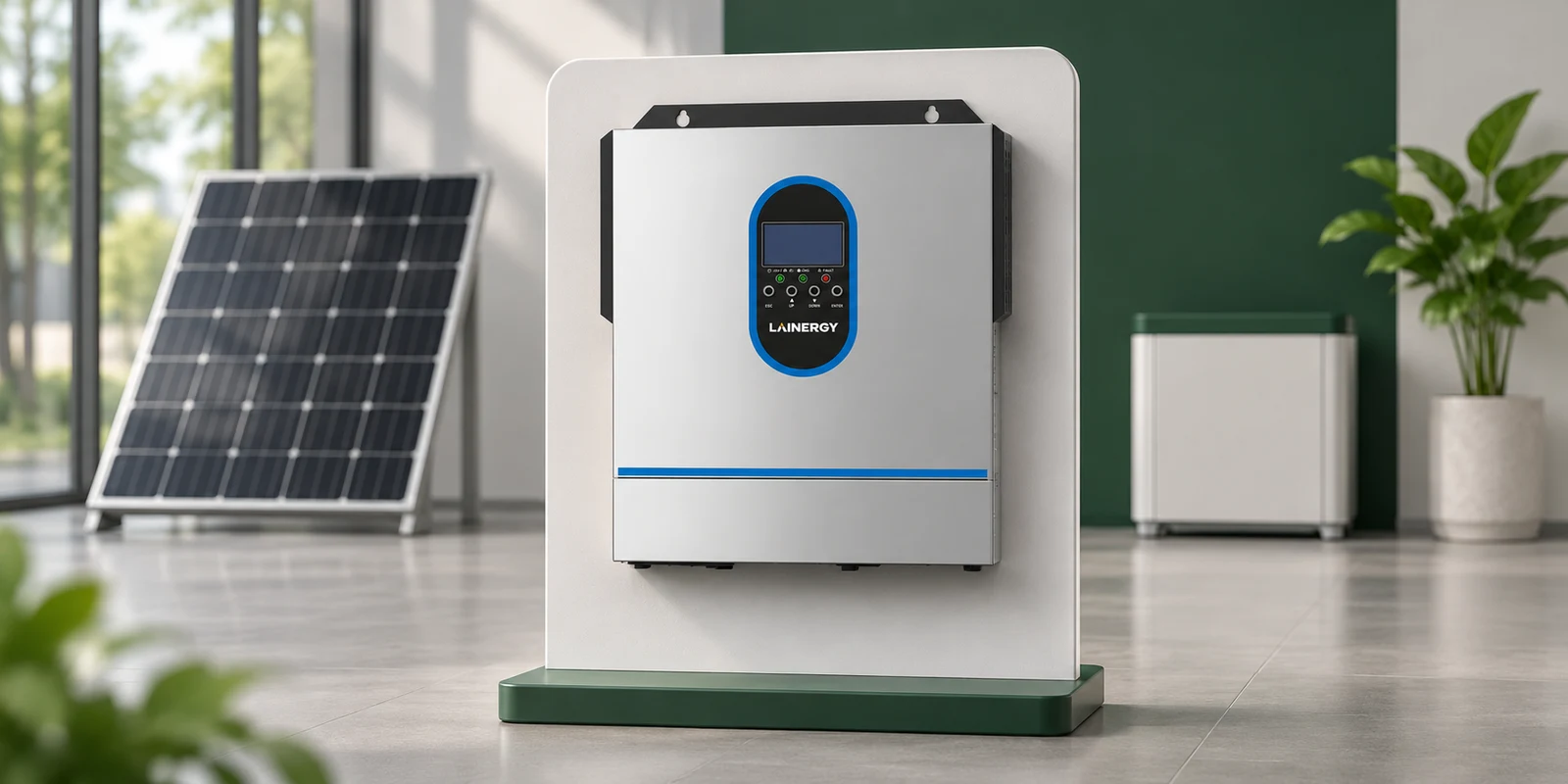
The LAINERGY WP-3.5K is an off-grid model listed at 3.5 kW with a 24 V battery system. The STH8EA is listed at 8 kW with a 48 V battery system in the hybrid range.
These are different power classes, so a direct unit-price comparison would be misleading. First normalize the requirement: continuous output, peak load behavior, battery architecture, PV inputs and destination AC configuration. Then compare models that can perform the same job.
The larger inverter also needs an appropriately sized battery bank. At an illustrative 8 kW output, 51.2 V battery voltage and 92% efficiency, current would be about 170 A. That calculation explains why selecting a larger inverter without reviewing the battery can leave the system unable to deliver its intended output.
What the quotation should say explicitly
Ask the supplier to identify each supported mode, the required external equipment and any limitations. Include the voltage and phase arrangement, battery pairing, continuous output conditions and the load-transfer specification.
For a generator-backed system, include the generator’s voltage, frequency, rated output and control interface. Do not treat the existence of an AC input as proof that all generators will work.
For a project requiring export, ask for the exact model’s export functions and the documents relevant to the destination. A product family name or another model’s certificate is not a substitute for checking the offered configuration.
Which category should a distributor stock?
Separate the assortment by customer job: remote independent supply, grid-assisted backup, and grid-connected energy management. Stocking by job makes it easier to prepare installation documentation, identify compatible batteries and reduce incorrect substitutions.
Use the off-grid inverter range and hybrid inverter range as starting points. Send LAINERGY one representative load schedule and destination specification for each customer segment through the contact form. Request a model-by-model operating-mode comparison before finalizing the assortment.