A hybrid inverter combines solar power conversion and battery charging or discharging in one unit. Depending on its design, it can coordinate solar panels, a battery and an AC supply. The word “hybrid” alone does not establish whether a model can export electricity, supply backup loads during an outage, or work with a particular lithium battery.
For distributors and installers, the useful question is therefore: which energy paths does this specific model support, under which conditions? A short operating-mode schedule is more useful in a purchase order than a long list of marketing features.
Follow the energy through the system
Solar panels produce DC electricity. An inverter converts DC into AC for compatible loads. Battery charging stores energy for later use; discharging supplies energy when production is insufficient. The US Department of Energy explains these inverter functions and notes that operating through an outage depends on how the system is designed.
Consider a small business with daytime solar production and evening lighting. During sunshine, solar may supply loads and charge the battery. Later, the battery may support those loads. If the battery reaches its configured reserve, the AC supply may take over. Each “may” needs confirmation in the selected inverter’s operating manual.
An AC input can serve charging or bypass functions without making the inverter an approved grid-export device. Likewise, a battery connection does not by itself prove automatic backup operation.
Turn “hybrid” into five purchase requirements
| Requirement | What to request | Why it changes the order |
|---|---|---|
| Solar charging | PV voltage window, maximum input voltage and current per MPPT | Determines which array configurations can be assessed |
| Battery operation | Supported voltage range, charge/discharge limits and battery protocol | Determines the battery pairing and usable output |
| AC supply | Voltage, frequency, phase arrangement and input limits | Determines suitability for the destination electrical system |
| Backup | Supported backup output, transfer behavior and restart conditions | Determines which loads can remain supplied |
| Export control | Explicit export capability, control equipment and applicable approval documents | Separates an export project from a backup or self-use project |
Have the supplier return this table with model numbers and document references. “Supports lithium” is an incomplete response when the proposed battery uses a specific BMS communication protocol.
Read power, energy and charging figures separately
The inverter’s kW rating describes output power under stated conditions. Battery kWh describes stored energy. Charging current, expressed in amperes, describes a different limit again. None can substitute for another.
For example, a hypothetical 4 kW load running for two hours needs 8 kWh delivered to the load. The battery must provide more than that after allowing for conversion losses and reserve. Buying an 8 kW inverter does not solve an energy shortfall in a small battery.
There is a second constraint on the DC side. At an assumed 51.2 V and 92% conversion efficiency, 4 kW AC requires approximately 85 A from the battery: 4,000 ÷ (51.2 × 0.92). This is an illustrative calculation, not a measured efficiency claim. At a lower battery voltage, the required current increases.
A practical example from the LAINERGY range
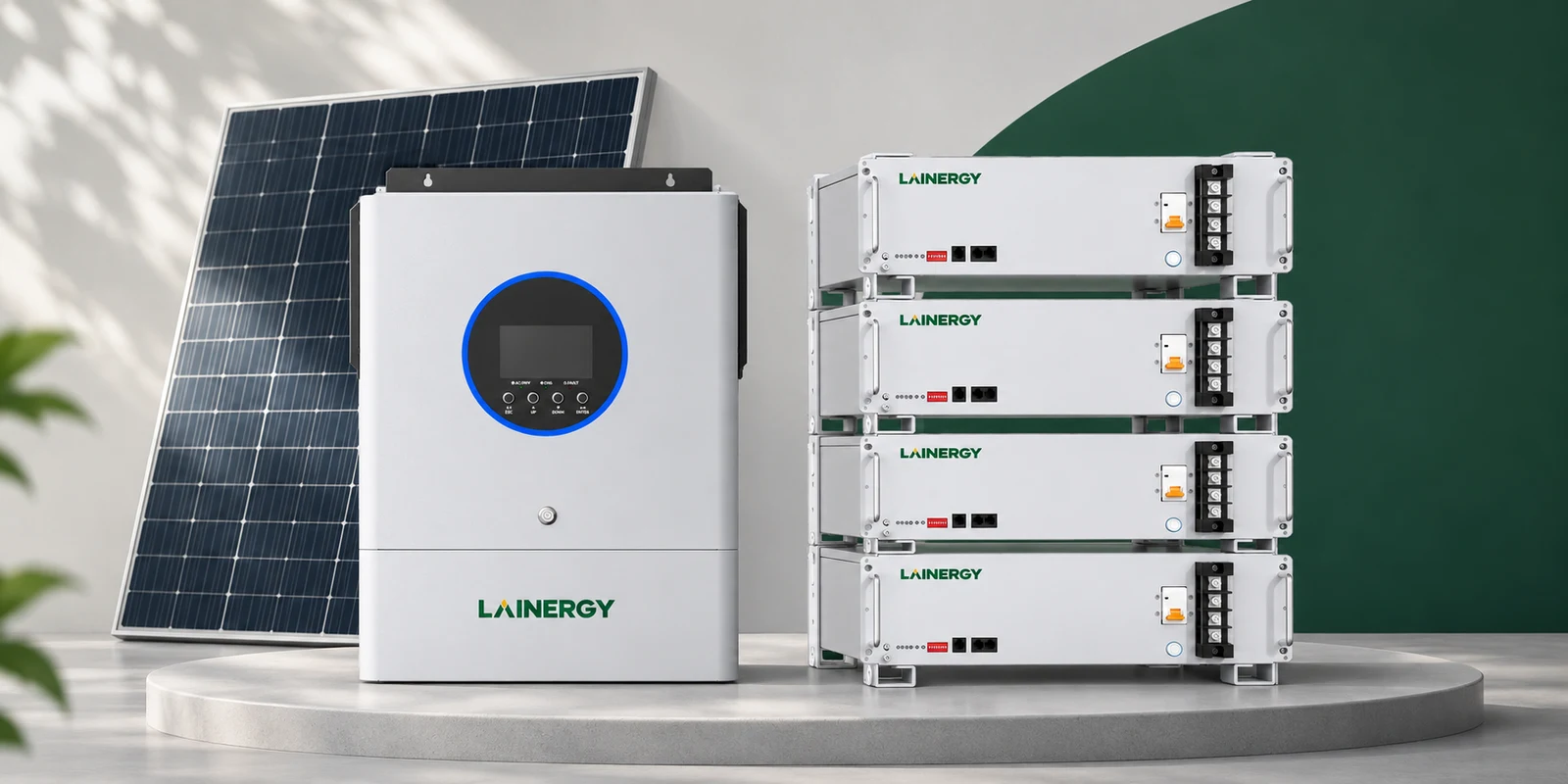
The STH8EA hybrid inverter is listed with 8 kW rated output, a 48 V battery system, 8 kW maximum PV array power and 120 A maximum charging current. These figures describe different parts of the equipment; they should not be added together as an output rating.
Its published battery-mode AC specification lists 220/230/240 V. A buyer supplying a 120/240 V split-phase project should request the appropriate configuration explicitly. A 240 V figure alone does not prove split-phase capability.
The next step is to match the chosen battery’s continuous current, voltage limits and communication requirements to the inverter. Review the wider hybrid inverter category when comparing output sizes, then keep the final quotation tied to one model and revision.
Does every hybrid inverter provide backup?
No. Confirm that the model supports the intended outage mode and identify the loads connected to that output. Ask what happens when the grid disappears, when the battery reaches its lower limit and when supply returns. A published transfer time also needs to be interpreted against the connected equipment’s tolerance; it is not a universal promise that every load will remain uninterrupted.
Can it operate without a battery?
Some designs can, but this must be confirmed for the exact model and operating mode. Solar availability varies, and a battery-free configuration may behave differently during a sudden load increase or low irradiance. Do not assume that a feature offered by another inverter in the market applies to the quoted unit.
Send an operating brief with the inquiry
For a useful recommendation, send LAINERGY the destination country, AC voltage and phase arrangement, largest simultaneous load, required backup duration, PV module datasheet and proposed battery model. State whether the project needs export, self-consumption, backup or independent operation.
Use the project inquiry form to request a model-specific response covering supported modes, battery pairing and the documents needed for your market. That response becomes the basis of a sample evaluation and purchase specification.