A two-hour battery system has roughly twice as much energy capacity in kWh as rated power in kW; a four-hour system has roughly four times as much. These labels are useful starting points, but delivered duration depends on usable energy, actual load, conversion losses, auxiliaries and operating reserve.
For a commercial project, select duration from the load event the battery must cover. A narrow demand peak and a long evening energy requirement can need different combinations of power and capacity.
Calculate the nameplate ratio first
Nominal duration in hours = nominal energy in kWh ÷ rated power in kW.
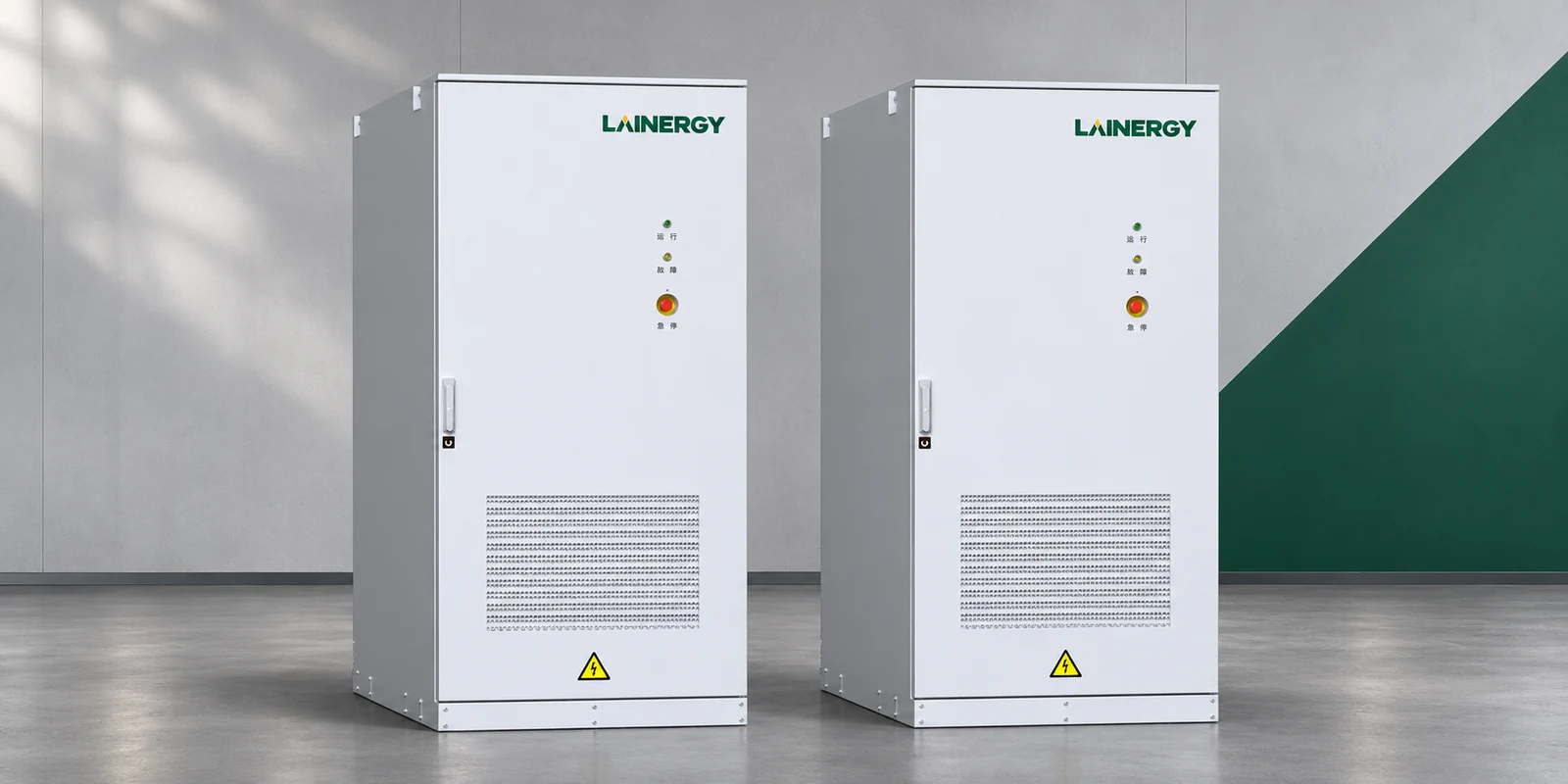
The following examples use the published LAINERGY product ratings. They describe nameplate ratios, not guaranteed AC discharge durations.
| Model | Rated power | Nominal energy | Energy ÷ power |
|---|---|---|---|
| SU261C131LM | 131 kW | 261 kWh | 1.99 hours |
| SU522C131LM | 131 kW | 522 kWh | 3.98 hours |
| SU522C262LM | 262 kW | 522 kWh | 1.99 hours |
The last two models illustrate the distinction clearly: the same nominal energy can be paired with different rated power. More kW allows a larger load to be supported, while more kWh at the same power extends the nominal duration.
Match the discharge window to the job
Suppose a hypothetical site needs a 100 kW reduction for 30 minutes. The energy associated with that rectangular event is 50 kWh. A different site requiring 100 kW for four hours needs 400 kWh delivered during that window.
These are deliberately simple examples. Actual peaks vary through time, so calculate energy from interval load data and check the maximum required power separately. A four-hour system is not automatically preferable when the main requirement is a short, high-power event.
The US Energy Information Administration discusses storage duration and capacity contribution in relation to the shape and length of peak periods. The same basic distinction is useful at a commercial site: the load shape determines which duration has value.
Move from nominal energy to delivered energy
For illustration, take 261 kWh nominal energy, a 90% operating window and an assumed 95% one-way conversion efficiency. The simplified AC energy estimate is 261 × 0.90 × 0.95 = 223.2 kWh. At a constant 100 kW, that corresponds to 2.23 hours before separately accounting for auxiliary consumption.
The percentages in this example are assumptions, not SU261C131LM performance claims. An actual proposal needs the supplier’s usable-energy definition and efficiency basis. Avoid deducting the same reserve twice if a quoted usable-energy value already includes it.
Also establish whether auxiliaries are included in the quoted AC energy or efficiency. Cooling, controls and other system loads affect the result, particularly at low discharge power.
Check the recharge opportunity
A system that discharges through the evening must have enough time and available power to recharge before the next required event. The charging limit, site import limit and available solar generation all affect that schedule.
Ask for a complete daily operating sequence. If backup reserve and tariff operation share the same battery, define which requirement has priority. Otherwise, an apparently adequate capacity can be unavailable when the highest-priority event arrives.
Specify the point of measurement
Write the requirement as power and energy delivered at a stated point, under stated conditions. For example: the required AC output, duration, starting state of charge, ending reserve, ambient conditions and whether auxiliary consumption is included.
Do not use a PCS peak-efficiency figure as the whole system’s round-trip efficiency. They measure different boundaries.
For a commercial storage proposal, send interval load data, the target discharge window, electrical configuration and reserve requirement to LAINERGY. Request a comparison of power and energy options against the same operating schedule.