Onduleurs hors réseau
Découvrez la gamme
Onduleurs hors réseau de 3,5, 8,5 et 11 kW destinés aux installations solaires, aux systèmes de batteries et aux systèmes d'alimentation de secours.
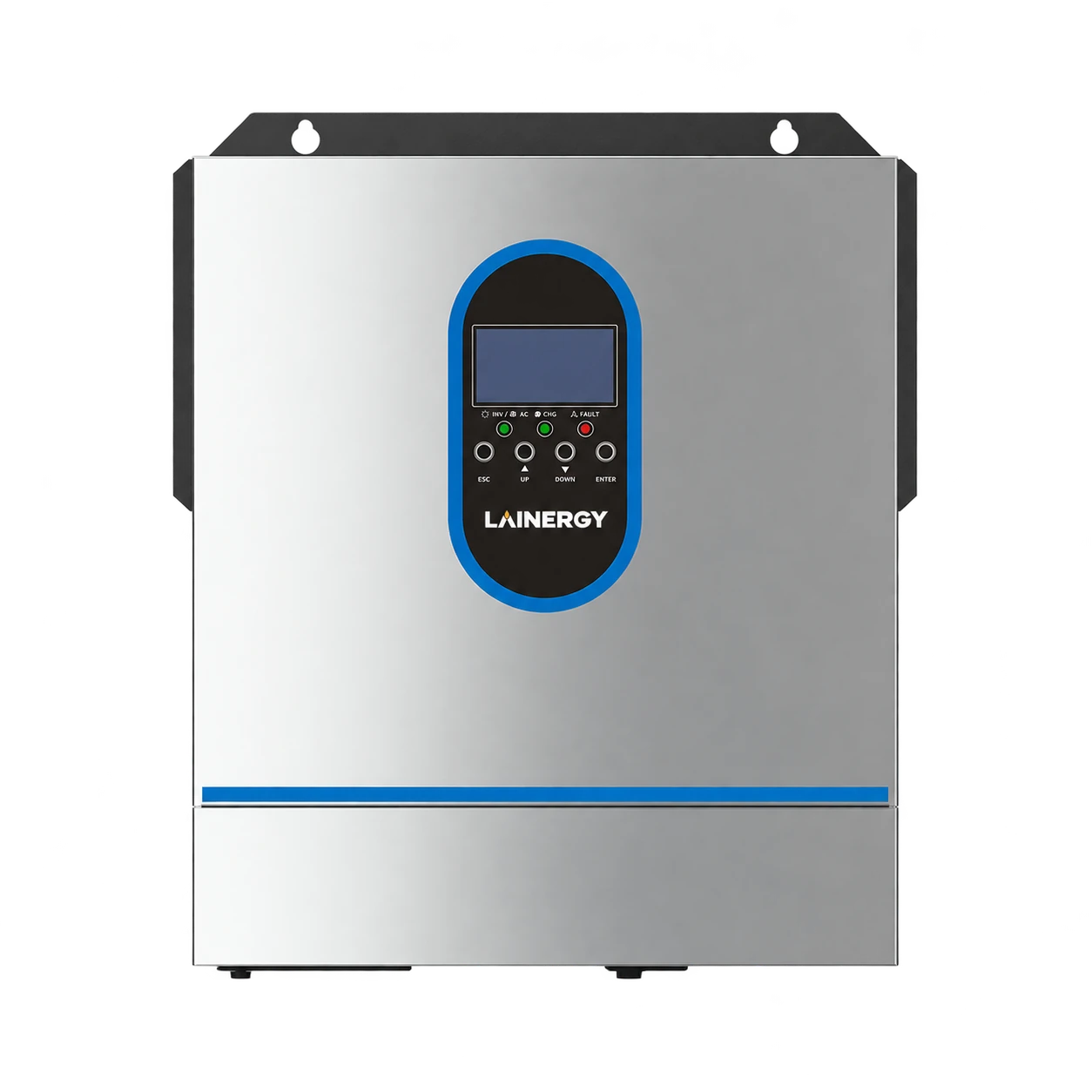

Off Grid Solar Inverters for Remote Power and Backup
LAINERGY supplies off-grid solar inverters for installers, distributors and project teams configuring independent power and backup loads. The WP range combines solar input and battery storage around three output ratings: 3.5kW, 8.5kW and 11kW.
Choose a model around the site’s connected load, battery voltage and available solar array. Share your equipment list and destination requirements to discuss a coordinated supply configuration.
Discuss an off-grid configuration
Compare the WP range
| Modèle | Puissance nominale | Tension nominale de la batterie | Puissance photovoltaïque maximale | Courant de charge maximal |
|---|---|---|---|---|
| WP-3.5K | 3.5kW | 24V DC | 4kW | 100A |
| WP-8.5K | 8.5kW | 48V DC | 10kW | 140A |
| WP-11K | 11kW | 48V DC | 11kW | 160A |
All three models list pure sine wave output and do not support parallel operation. Review the full specifications for WP-3.5K, WP-8.5K and WP-11K before finalizing the system.
Start with power and daily energy
An off-grid system needs enough inverter power to operate its loads and enough stored energy to keep them running between charging opportunities. These are separate calculations.
Prepare a load schedule showing equipment wattage, hours of use, operating times and startup demand. Identify which loads must remain available during poor weather and which can be delayed or disconnected. A refrigerator, pump or workshop motor may require a different starting allowance from lighting and communications equipment.
For energy planning, multiply each load’s power by its operating hours, then account for conversion losses and reserve capacity. For power planning, assess the loads that run simultaneously and their startup behavior. The resulting battery and PV requirements should be reviewed together.
Choose the correct battery architecture
The WP-3.5K uses a 24V battery system. The WP-8.5K and WP-11K use 48V systems. Do not pair a battery with an inverter solely because both appear in the same product catalogue.
At a given output power, battery voltage affects DC current and the design of connections and protection. The selected battery must support the required discharge current and remain within the inverter’s voltage limits. Charging must also respect the battery’s current and temperature restrictions.
Our residential battery category includes 51.2V storage products for technical matching with appropriate 48V systems. These are not direct replacements for the WP-3.5K’s 24V battery requirement.
Coordinate solar input and backup charging
The published WP specifications list a 60–500V DC MPPT range and a maximum PV voltage of 500V DC. Check module open-circuit voltage under cold conditions, operating voltage under hot conditions and the current presented to each input.
A higher module wattage does not guarantee a suitable electrical match. Review the selected solar PV modules alongside the inverter’s individual input limits.
If the project includes generator charging, provide generator specifications and the intended operating sequence. Input quality, charging current and the combined demand from loads and charging need review before the equipment is treated as an integrated system.
Plan for installation and future demand
Confirm AC voltage and frequency, installation conditions, ventilation and access for maintenance. The WP-3.5K lists 220/230V AC output, while the larger models list 220/230/240V AC; the published frequency specification is 50/60Hz.
Because the current WP models do not support parallel operation, growth should be considered at the initial design stage. Options may include a different inverter size or separate load groups, subject to engineering review. Our remote energy solutions page is the starting point for projects involving solar, storage and backup generation.
Frequently asked questions
Which off-grid inverter ratings are available?
The current range includes 3.5kW, 8.5kW and 11kW models. Their battery voltages and PV input limits differ, so compare complete specifications before choosing.
Should I choose a 24V or 48V battery system?
Choose the architecture as part of the complete load and battery design. WP-3.5K requires 24V, while WP-8.5K and WP-11K require 48V nominal battery systems.
Can the inverter start my motor or pump?
This depends on startup power, startup duration, simultaneous loads and battery current capability. Send the motor or pump specifications for review; running watts alone do not establish compatibility.
Does the selected model need a battery to operate?
Battery-free operation needs confirmation for the exact model and application. Do not assume reliable operation through changing sunlight or load startup without reviewing the manufacturer’s operating requirements.
Can a generator be used for charging?
Generator integration should be reviewed against the selected model’s AC charging requirements. Provide generator capacity, voltage, frequency and control details so the configuration can be assessed.
Can the WP models operate in parallel?
No. The listed WP models do not support parallel operation. A project requiring synchronized parallel units needs a different configuration.
How should PV strings be matched?
Check maximum input voltage, MPPT range, input current and permitted PV power. Include temperature corrections and module specifications in the design review.
Which output voltage and frequency options are available?
Published output specifications cover 220/230V for WP-3.5K and 220/230/240V for WP-8.5K and WP-11K, with 50/60Hz frequency specifications. Confirm the order configuration for the destination.
What installation conditions are required?
Use the selected model’s installation instructions for environmental limits, ventilation, wiring and protection. Share details of heat, dust, humidity or other demanding site conditions before ordering.
What should I include in a bulk-order enquiry?
Include quantity, destination, load schedule, battery voltage, PV specifications and delivery requirements. Identify any generator interface, documentation or service needs separately.
Request an off-grid supply proposal
Send the site load schedule and proposed battery and solar configuration. Contacter LAINERGY to review product selection, order quantities and project requirements.